From “My Child” to “Our Children”
I grew up with very little service involvement as a youth. I was taught to be kind and give when opportunity presented itself, but that was pretty much it. When my second child, Charlotte, arrived later in life, I wanted her to have opportunity to “give back” and come to understand the larger community family of which she was a part; that having all of her needs met was not the case for everyone.
When Charlotte was five, we took her to visit our local hygiene cabinet, explaining that people who needed these items could get them there. She loved meeting the staff and on the way home we talked about why people might need to go there and what else we could do to help. She was eager to learn and engage with adults in the community. She wanted to do more. Part of her weekly allowance became earmarked for hygiene items, and then we taught her matching funds – matching the amount she contributed to community needs each month.
As adults in the community came to know of her involvement they offered to give. Since she was giving regularly, she naturally expected they would do the same – maybe even matching funds to her contribution. Staff of other community based organizations asked to be included in her project, Charlotte’s Circle. The purity of the young child seemed irresistible to adults and she met their interest with her desire to take on more. Between the ages of five and seventeen, she raised and managed over $70,000 for needs in her community.
As I watched Charlotte grow with the project in her life, the idea of replication – what would happen if more children and families were doing this – became a recurring thought. One day, the director of our United Way commented to me that she “wished we could do something about the food problem in our community.” This was a turning point for me. Replicating projects for a variety of community needs became important. My professional interests turned to service learning. I began to create a database of service projects organized by topic.
The mother in me had shifted from Charlotte to all of our children – from my community to all communities. I think there is a certain idealism that grabs hold of us when we raise young children; what the world could be seems a point of conscience.
The final piece that kicked in was the imperative to start young – to create a foundation of service in the education of our children. So I worked with elementary grade teachers to create a sequence that could start in kindergarten and build up through each grade – a leadership role for each grade, tied to the topic areas that had formed in the database.
In a world that adults have not been able to manage, perhaps creating such a foundation for the next generation can head us toward sustainable solutions to the challenges we face.
American Youth Are Unique – Let’s Play to Their Strengths
We need to establish our American identity in our system of education. Our youth are Americans who want to participate in meaningful ways. They want to explore the world and connect with others, they want voice. American youth want to create meaningful change, and know they are capable. As older Americans, we may seek their engagement in the classroom, but they seek engagement in the real world. Our youth are ready, eager, emerging pioneers; and we have a host of unsolved, real-world problems in need of fresh perspective and sustainable solutions.
In developing areas of the world we can see the central role of education in creating change. We see youth – very small children – with strong motivation to learn and they succeed with immediacy and strength in academics. It is easy to see the source of motivation for these children: improved living conditions. As children they bear similarity to our own: they want to help, they want to take action. Relevance is the key that links their energy with education; relevance and purpose are the foundation for motivated learning.
Our youth need real world challenges and problem solving to become excited about their education. American youth need opportunity to give, and create change; to find their place in the community and the world. They need real world relevance to kick-start the gears and ignite their enthusiasm to learn and find purpose in education. We need to listen to our youth because they tell us what they need. In student surveys our youth typically request:
- Learning by doing
- Hands-on project learning
- Relationships with the outside world
- Interaction with people beyond the classroom
- Using technology to interact and communicate
- Opportunity to solve real-life challenges
The ability of our youth to learn and produce quantifiable results is no different than youth in other countries. American youth are eager to learn and have perspective on how they learn best. We need to call forth our entrepreneurial strength and create a new avenue of education that resonates with our American identity: our desire to engage and create, our humanitarian outreach, our ability to problem solve with wide berth of perspective and embrace.
The inclusion of a service initiative – a service curriculum that starts in kindergarten and runs through high school – will provide the opportunity for this needful inclusion of real world problem solving in real world time that our youth need to thrive. It will incorporate the missing puzzle piece of relevance that will connect the energy of our youth with education. It will allow young Americans to use technology to communicate with their peers nationwide, to find real world leadership roles in creating needed change, to create relationships worldwide. We need to recognize what makes us tick – what makes us unique. We need to play to our strengths.
High School Dropout Can Fade Away
We need to start at the beginning – at the root – to grow strong, interactive engagement with our youth and rediscover the heartbeat of education that is alive with relevance. We need to give our youth voice and opportunity for engagement with us in the real world that can grow with them from kindergarten all the way through high school.
Our children are excited to go to school when they come of age. Without the needed nutriment of purposeful, real life engagement we watch our American youth wilt – gradually at first and then more markedly – over a period of thirteen years. Even the “best students” (those who produce the results adults want to see) know that it is a struggle to stay inspired. As parents, it is hard to witness the contrast between academic success and their lack of inspiration – the contrast between their excitement as small children to go to school and their resignation to put in another day in high school.
The problem we identify as dropout or truancy is more widespread than dropout rates indicate. Many of our youth who do not drop out also struggle to cope with their school environment – the continuing singular yardstick of individual test scores; tests created by others that identify their worthiness for inclusion in a future that lies ahead. High school dropout is a strong move on the part of youth who resist this system and opt out.
In a K-12 service initiative, assessment would expand to include multiple, valuable workplace and life skills; skills that are assessable in live time, not in traditional test form; skills that are evident to others on the “team” – classmates. Our youth would engage with one another and cross-pollinate their enthusiasm among themselves; an enthusiasm that crosses over into academic subject matter that connects the classroom to the real world in which they live. This enthusiasm would spin out into the hallways, our homes, and our communities.
Our youth can address the issue of high school dropout among themselves if we give them real world engagement opportunities. They can find their place in the world and the support education can bring to their lives. They can create community within their schools.
A national K-12 service initiative would open wide a realm of future possibilities interwoven with consideration for others and the environment. We need to step back, grab hold of the larger picture within which the classroom fits, and problem solve a sustainable strategy. We can gather our resources and create an inventive, American solution that will not only solve this issue, but a host of other challenges we face in our communities, nationwide, and worldwide.
We – the People – Are the Inspiration
If we gathered all the service projects we have created – and organized them by topic so we could see what we have, we would find overwhelming evidence that as a people, we are wonderfully equipped with capability.

We already have so much of what we need. Beyond the project details, there is an incredibly inspirational quality in the way we step up to the plate to help and come together when we need each other.
The projects and outcomes alone are inspiring, but there’s more. There are the project originators – the stories about how they not only saw a need, and a solution but were drawn into a sense of commitment that changed the direction of their lives. They talk of the satisfaction they find in their service work. They have a clear sense of purpose. They innovate. They work hard, and they seem happy. They are outstanding individuals who reveal our capability as well.
When a crisis occurs – in our community, in another state or across the globe – we demonstrate this capability. We rally to help, to reach out, to problem solve. We organize. We have a track record for strong, quick response – and we try to sustain these efforts to meet the level of need.
I caught a snapshot of this capability when I worked with first year college students in a service learning course. They were full of inspiration and promise, ready to engage – to bring more food to people in need in our community. They were ready to research models from other communities and meet with people to make things happen.
The director of our food bank not only came to class to talk with students about possibilities they had researched; he started attending the class and worked with them in the community. He was willing to adjust his work schedule because he also still held the belief that we could do more, that it was possible to do better.
The children in our elementary schools reflected the same energy and readiness to help. They proud to be included in helping to meet a genuine community need, and proud of their accomplishments.

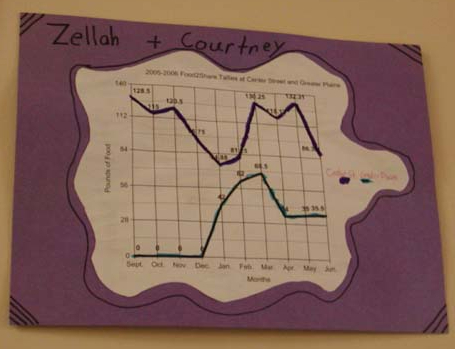
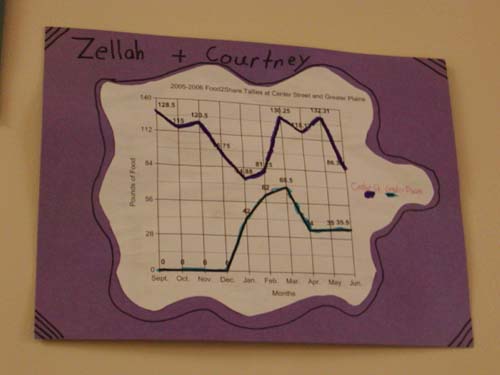
A fifth grade teacher asked her students to graph food donation outcomes, connecting their service work to academics. When sixth grade students were asked to share personal reflections, they wrote with enthusiasm as community members, expressing the hope that more schools would adopt the program.
We have so much to bring to the table – we have problem solved, we have developed and sustained solutions, we continue to innovate, and we continue to care – and we see the evidences of the same in our youth. We – as a people – are the inspiration that can take us forward into solution-making that is off the charts.
Wildlife and Endangered Species
For some, the concern for wildlife seems peripheral; other needs must come first. This perspective would seem a blind spot to those who champion endangered species as one of many primary issues we must address as a people – a people capable of understanding the interwoven connections that make the whole of our world work.
At present we vie among ourselves for causes, for resources and attention. A K-12 service initiative would resolve this disorganized competition for our support. We can draw our humanitarian and environmental problem solving into an overview with specific categories, allowing us to work more effectively, share approaches, and track outcomes. The beauty of a K-12 service initiative is that it would place this work in our system of education – where it belongs – providing the real world involvement our youth so desperately need, demonstrating real-life relevance of education.
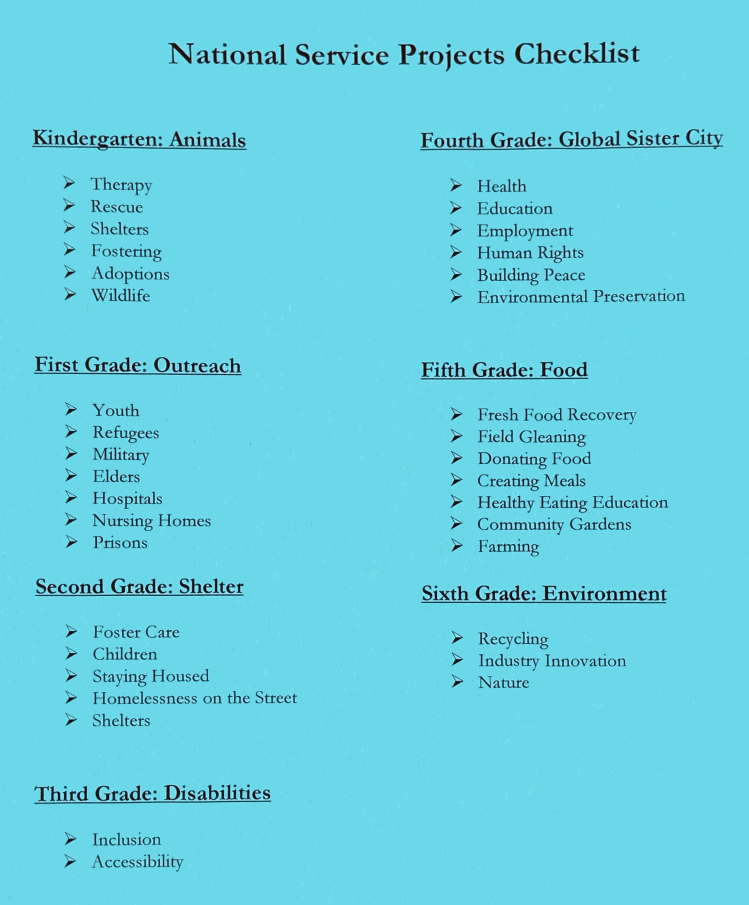
A nationwide service curriculum would divide into topic areas that are not only introduced at each grade level K – 6, but involve our youngest in managing the community checklist of projects for their grade level topic, providing leadership roles and exposure to all work in their topic area. Students would build relationships nationwide with their peers as they progress together from grade to grade, topic area to topic area, coming to know themselves as a nationwide graduating class.

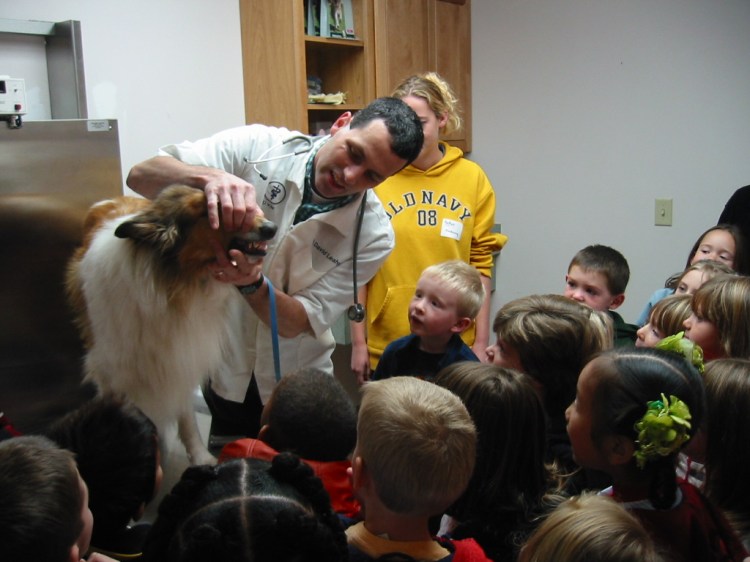
The service topic of endangered species and wildlife would be aligned with kindergarten. Caring for Animals, a year-long service learning project brings our youngest into regular contact with their local humane society, working to address needs at the local level. Beyond their service project, they would manage the community checklist of service work related to animals. Older students in classes with helpful academic overlaps, community members, and staff of the humane society would check-in with kindergarteners to help update the checklist of work in the community in this area. In addition to local work, each school system could adopt an endangered species to support, working with the appropriate national organizations committed to this environmental topic area.
Kindergarteners seem so small and incapable of real world contribution, and yet they represent the beginning, the beginning of a foundation. As they grow and engage in more service topic areas of leadership, they will come to know how they can continue to contribute as older students, as adult community members. They will see opportunities to continue our forward progression to meet the challenges we face.
It would be so easy to help our endangered species and care for our wildlife with our true wealth – ourselves, our knowledge, our intelligence, our energy, inspiration, and caring. Our youth are ready and eager for the opportunity to take the lead in each and every area of challenge and problem solving. Let’s give them the leadership roles they deserve and build forward with them – all of them – our youth nationwide and worldwide. They can take the lead and carry us forward into wide scale solution making with all the resources at hand to make it happen.
Solution in Our Midst

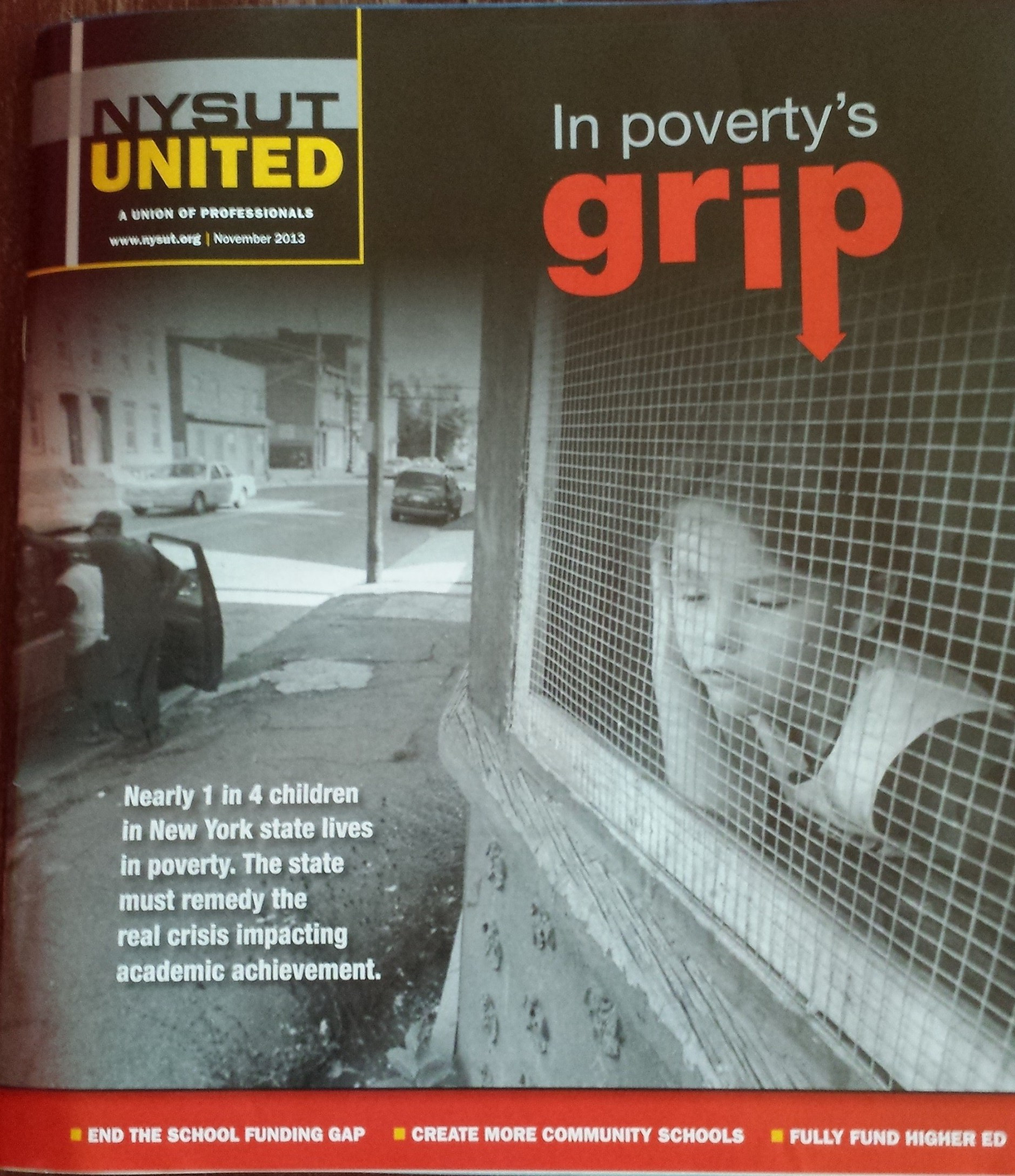
My husband teaches language arts in our local middle school and he receives publications from NYSUT (New York State United Teachers). I was struck by the recent cover photo and the statistic: 1 in 4 children in New York live in poverty.
When I think of poverty, the first thing that comes to mind is food: having enough food. The idea that a child who doesn’t have enough food can’t function well in the classroom makes sense to me. The idea that 1 in 4 children experience this in my state is mind-boggling. I do know, however, that we haven’t met the need for food in our community and that the same is true in other communities.
The article focuses on the gap between the rich and the poor:
- Poverty as the daily reality, the fundamental obstacle that educators, health care workers and public service providers face each day – in rural, suburban or urban communities.
- Economic policy, deregulation, tax structure, political will, debt battle, government shut down, polarization
- The widening gap between rich and poor, the hollowing out of the middle class.
The article states that there is “little to suggest that change is in sight” which is typically where we end up in our adult conversations. There is little to suggest change is in sight because we continue to look in the direction of the above. As adults, we have created complicated scenarios and we argue within this web. We argue more than we accomplish. Well not all of us. It’s time we turned our attention to the solution makers.
Some of us have heard about Pam Koner or the project called Family-to-Family. Some of us have joined with her to create the solution that is needed: shared prosperity. Pam is a project originator, a role model, someone who can help us replicate. We can build with her, with those who already do. We can educate our children about this need and solution. We can participate with our children.
It’s time we turned the the focus of education and the attention of our youth toward the solution makers – to learn from them, become involved with them. It’s time to provide opportunity for our youth – the next generation – to participate in generating these solutions; to learn how to work together with clear goals, how to tend to the self and to others; to experience how good it feels to accomplish goals and make things better.
All that we need, we have. We have allowed the wrong models to take center stage for too long. We are more intelligent than this. We need to look in the direction of where the real power to change lies – among ourselves as a people. We are doing it – in small and large scale. We just have yet to position what we have to hit the home run and see our efforts come together in truly large scale.
We Can Start Now; We Don’t Need Permission
We can start now. We don’t need permission. There are no obstacles. We have everything we need:
- A unified service learning curriculum
- Schools nationwide
- Non-profits in every community
- Project originators
- Online communication
Service learning is an established methodology for coordinating traditional academics with genuine, real life, current time, community needs. Bringing genuine community needs to the classroom for problem solving is not new. Problem solving in this context inspires students to engage in their learning environment. Service learning is incorporated into college curriculum for education majors nationwide. Teachers do not need permission to use service learning. It is a simple, well-founded, available teaching tool.
Our youth are desirous of the relevance and real-life interaction that service learning brings to traditional academics. We have come to discover that without genuine student engagement, grades drop, assessment reveals lack of knowledge, high school dropout rates increase, and even those students doing well may not be inspired to go to college – unsure of where they fit in the larger life context; unsure because we have excluded them from real world involvement during their formative years. Although they tell us what they need, we have yet to listen and create a solution with them.
Our community based non-profits have always been desirous of support from community members, and they actively invest in educating our youth, coming to our schools to describe the work of their organizations. Community non-profits are immediate in response to the opportunity to engage in service learning projects with our youth, moving beyond initial introductions to their organizations to define specific needs, provide statistics, and confirm the real life value of students’ contributions. Our non-profits hope for continuing, cooperative working relationships with community members.
Communication systems allow us to coordinate with immediacy – beyond the classroom, beyond our local communities, beyond our state borders. Our youth and teachers have the tools, the support, and the ability to reach out to their peers – to compare and assess needs, solutions, and progress. We live in a country where we don’t need permission to communicate and coordinate, to come together to problem solve among ourselves with resources at hand.
Solution models are up and running in communities across the world. We can link our youth in widespread solution making with project originators – project originators who can instruct, and involve our youth; to not only create in the present, but to sustain into the future; to not just talk about needed change, but to initiate and sustain it.
We have become accustomed to delay. We have become accustomed to inaction. We have become lax. It is time to embrace that which we can do: to identify needs and solve them with the tools we have; to coordinate without debate; to make things better. We owe this to our children. We owe them far better role modeling than we have been providing. We can start now. We don’t need permission.
One Point of Agreement: Topics K – 6
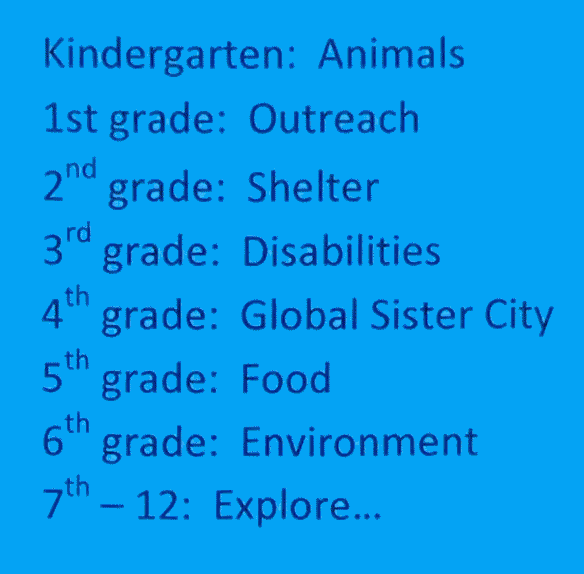
Leadership topic areas from kindergarten through grade six are a fundamental point of agreement for this initiative to take off. We need to come together on this alignment of topics to create connection among ourselves nationwide; to create the most significant and comprehensive momentum, support, and outcomes. The following distribution would provide this necessary base line structure:
This distribution of topics is not arbitrary. It evolved among teachers in my community as they assessed the fit between possible service learning projects, age and curriculum. Non-profits readily adapted to the age groups, parents confirmed the need and value of this engagement in service, and administrators gave full support.

Each grade has a signature project to manage, and takes responsibility for updating all community project information in their topic area, thus creating familiarity with the broader scope of project work in their service area. Older students and community members would communicate with the content related elementary grade when signing up to take on a project/need, and to update project outcomes. A national checklist of outstanding project models would support the community checklist.
This organization of our service work provides a way to:
- Know who is doing what
- See needs that are unaddressed
- Track our community efforts in specific topic areas
- Access outstanding project models
- Work with others on similar projects throughout the country
- Combine our outcomes nationwide
Placing our youngest in the management role for specific topic areas creates:
- A strong foundation in civic engagement
- Teamwork among youth of different ages
- Nationwide student interaction at each grade level
- A real-life, hands-on, purpose driven context for K – 12 academics
- Sustained service involvements in our communities
As middle and high school students engage in more complex project work, they become role models, supporting their younger peers in management roles they once held. These emerging young adults will find themselves in the midst of ongoing personal and community development that connects them with a variety of interpersonal and professional relationships. As topic areas become known nationwide, a common frame of reference for service involvements in every community provides stability in a highly mobile society. We can always find an extensive, well-organized community checklist of projects, with our youth in charge.
Full flexibility resides within this base line structure, allowing for autonomy of choice as well as alignment with others. To agree on a framework of topic areas provides a way to communicate and coordinate – critical elements in service work and social responsibility. With this simple structure, we can move forward with immediacy; we can engage in outstanding project models that have grown from within ourselves – created from the desire to help others, to reach out, to take action and create solutions.
Obesity: A National Concern
There are numerous studies and reports on obesity as a modern day epidemic in our country. The solution seems simple: we need to move, to be active, to exercise, and we need to consume foods that are good for us, whole foods, balanced meals, reasonable quantities. None of this is new. The dilemma is how to correct a misdirected impulse that has permeated our population.
Starting at the beginning, looking for root areas to grow the right end result, brings us to out youth. As a nation, we can start together with our youth in their educational environment,
There are so many things we need to teach our youth about our world. We are fortunate that as we find ourselves in the midst of an issue to problem solve, like obesity, that there are those among us who have been developing solutions. There are solutions that we can tap and work on together – we can share these models – we can share the outcomes and next steps. We are fortunate to have the ability to communicate with immediacy.
The solution models we have been building can be woven into a well-integrated education alive with real-life relevance. We can include models that increase physical activity, models that explore whole foods with our youth, models that wrap this into organic gardening and cooking, models that incorporate vermiculture, composting, and recycling.
Our system of education embraces so many disciplines, creating a single location for work in all of these areas. There is, quite simply, no societal dilemma we face that we cannot bring to the education of youth and teachers for problem solving. Schools are a think tank predisposed toward activism, with youth desirous of inclusion in real life, real time engagement, wanting to act upon that which they are taught. We can educate and problem solve at the same time.
It is time to use the resources we have and link them to education with an established tool – service learning – and begin making the changes needed, together. We can initiate this now, among ourselves. We can draw from models we have created that are of the people, we can create more together, by the people, and better our local, national and global conditions for the people.